

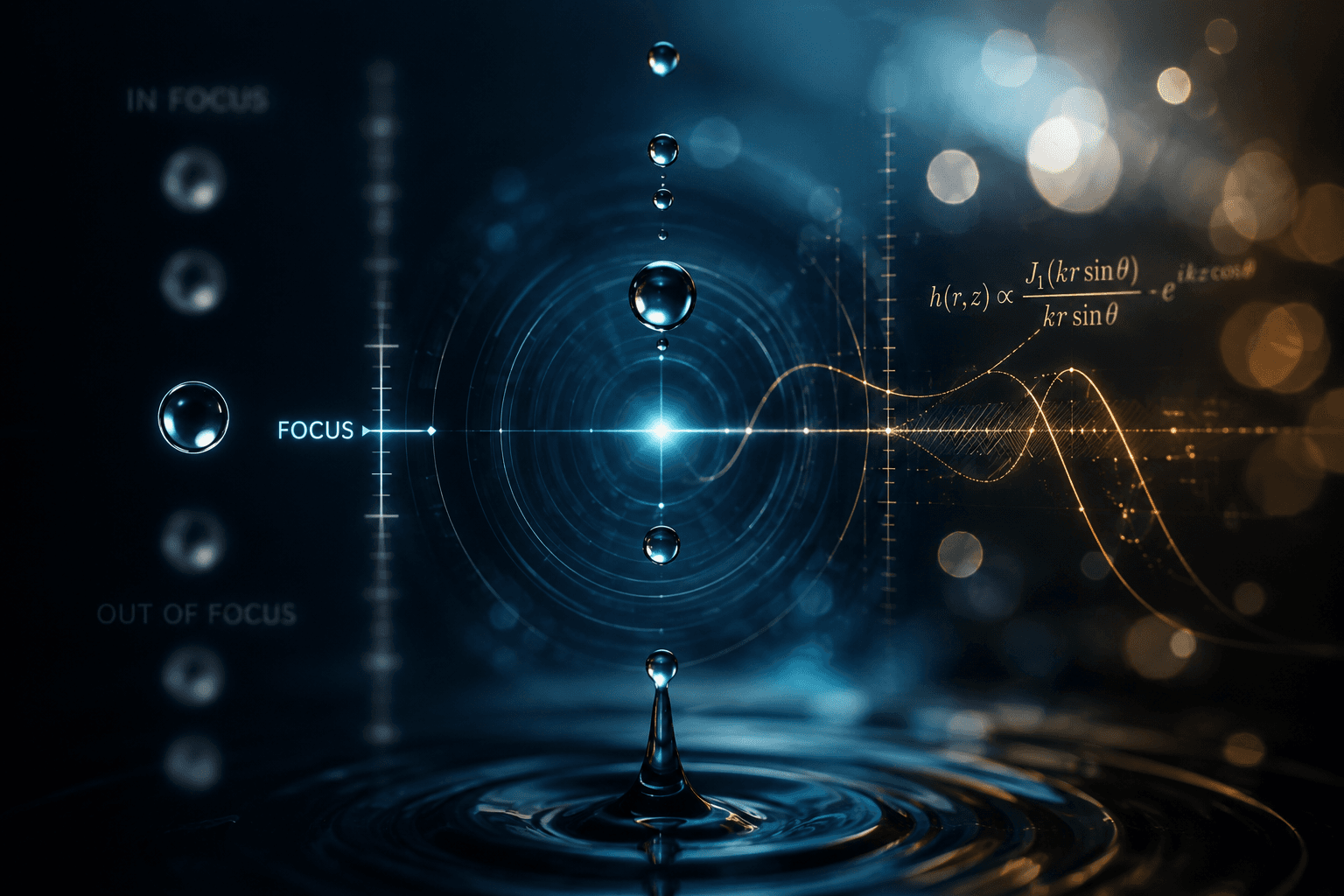
Das Fokussieren eines Tropfens klingt nach dem einfachen Teil der Tropfenbeobachtung. Optisch ist es jedoch alles andere als einfach – und was mit Ihrer Messung geschieht, wenn der Tropfen die Fokusebene verlässt, ist einen genaueren Blick wert. Dieser Artikel geht näher auf ein Thema ein, das wir kürzlich auf LinkedIn angesprochen haben: Welche Auswirkungen hat Defokussierungsunschärfe tatsächlich auf die Tropfenmesstechnik, welche Strategien gibt es, um damit umzugehen, und was verändert ein unschärfetolerantes System in der täglichen Praxis?
Warum die Fokusebene kleiner ist, als Sie denken
Jede Tropfenbeobachtungsanlage – egal, ob man Picoliter-Tintenstrahltropfen oder Nanoliter-Punkte aus einer Düse beobachtet – unterliegt einem grundlegenden optischen Kompromiss: Vergrößerung versus Schärfentiefe. Die Abbildung kleiner Tropfen erfordert Vergrößerung und numerische Apertur, und die Schärfentiefe nimmt in etwa mit dem Quadrat der numerischen Apertur ab. Der Bereich, in dem ein Tropfen wirklich scharf erscheint, kann am Ende schmaler sein als der Tropfen selbst.
Nun kommt noch die Realität hinzu:
Tröpfchen befinden sich im Flug. Sie durchqueren die Fokusebene, anstatt darin zu verweilen, und schräg ausgestoßene Strahlen driften entlang ihrer eigenen Flugbahn aus dem Fokus heraus.
Satelliten und Ligamente – oft die diagnostisch interessantesten Merkmale – liegen selten in derselben Ebene wie das Haupttröpfchen.
Bei Druckköpfen mit mehreren Düsen kann nicht jede Düse gleichzeitig den idealen Arbeitsabstand einhalten.
Im Laufe stundenlangen Betriebs verschieben thermische Drift und mechanische Toleranzen still und leise den Fokus, den Sie am Morgen eingestellt haben.
Nichts davon ist ein Bedienerfehler. Es ist Geometrie. Die Frage ist nicht, ob Sie leicht unscharfe Tropfen messen werden – das werden Sie –, sondern wie sich das auf Ihre Messwerte auswirkt.
Was Unschärfe tatsächlich mit einer Messung macht
Unschärfe wirkt wie ein Tiefpassfilter: Die scharfe Kante eines Tropfens wird zu einem allmählichen Intensitätsverlauf verschmiert. Die klassische Bildverarbeitung muss dann entscheiden, wo in diesem Verlauf das Objekt endet – und diese Entscheidung verschiebt sich, je stärker die Unschärfe zunimmt. Der erfasste Durchmesser hängt zunehmend von der Fokusposition ab.
Bei der Volumenmesstechnik wird dies durch einen gnadenlosen Hebel verstärkt: Das Volumen skaliert mit der dritten Potenz des Durchmessers. Ein Fehler von nur 1 % beim erfassten Durchmesser wird zu einem Fehler von 3 % beim Volumen; ein paar Pixel Ungewissheit an der Kante eines ~100 µm großen Tropfens können den Volumenmesswert um mehrere Prozent verfälschen. Wenn die erfasste Größe mit dem Fokus driftet, zeigt Ihr Volumen-Trenddiagramm optische Effekte und nicht den Prozess.

Ein Blick hinter die Kulissen: Modellierung der Defokussierung
Die gute Nachricht ist, dass Defokussierungsunschärfe kein zufälliges Rauschen ist – es handelt sich um bemerkenswert gut vorhersehbare Physik, und das macht sie modellierbar.
Die scheibenförmige PSF. In der geometrischen Optik wird eine defokussierte Punktquelle als kleine, gleichmäßige Scheibe abgebildet (der „Verwirrungskreis“). Ihr Durchmesser wächst linear mit der Defokussierungsentfernung und mit der numerischen Apertur. Das unscharfe Bild ist dann mathematisch gesehen die scharfe Szene, die mit dieser scheibenförmigen Punktstreufunktion (PSF) gefaltet wurde: Jeder Punkt des Objekts wird durch eine kleine Scheibe ersetzt, und alle Scheiben überlappen sich zu dem sanften Übergang, den man am Rand sieht. Dieses einzige, einfache Modell beschreibt bereits überraschend gut reale, defokussierte Tröpfchenbilder.
Wo die Bessel-Funktionen zu Hause sind. Leser unseres LinkedIn-Beitrags erinnern sich vielleicht an die Warnung, dass eine strenge Herangehensweise schnell zu Bessel-Funktionen führt. Hier ist der Grund dafür: Beugung. Selbst ein perfekt fokussiertes, aberrationsfreies Objektiv kann einen Punkt nicht als Punkt abbilden – die Wellennatur des Lichts breitet ihn in das Airy-Muster aus, dessen mathematische Form auf einer Bessel-Funktion erster Art basiert. Die Airy-Scheibe ist die verbleibende Unschärfe bei maximal erreichbarer Schärfe, die durch die Blende vorgegebene Untergrenze. Das Beruhigende für die Tropfenbeobachtung: Bei realistischen numerischen Aperturen dominiert die Beugung nur innerhalb der letzten wenigen Mikrometer um den perfekten Fokus herum. Verschiebt man sich um einige zehn Mikrometer nach außen, ist die geometrische Scheibe um Größenordnungen größer als das Airy-Muster – das einfache Scheibenmodell gewinnt die Oberhand. Monochromatische Blitzbeleuchtung hilft zusätzlich, indem sie chromatische Unschärfe vollständig aus dem Bild entfernt.
Messung der Unschärfe. Da die Breite der Kantenrampe direkt mit der Größe der PSF zusammenhängt, lässt sich die Unschärfe selbst anhand des Bildes messen – beispielsweise als Maß für die Kantenbreite zwischen definierten Intensitätsstufen. Eine einzige Zahl pro Bild („Unschärfeindex“) gibt Ihnen und der Software dann Auskunft darüber, wie weit dieser bestimmte Tropfen vom Fokus entfernt aufgenommen wurde. Falls Sie die kleine weiße Zahl in der Ecke unserer Messbilder gesehen haben: Genau diese Idee kommt dort zum Tragen.
Die Werkzeugkiste: Wie man mit Unschärfe umgehen kann
Sobald die Unschärfe als Faltung mit einer bekannten PSF-Familie verstanden wird, eröffnen sich mehrere Strategien. Jede hat ihren eigenen Charakter:
Bildrestaurierung (Dekonvolution)
Der mathematisch elegante Weg: die Faltung rückgängig machen. Da die Faltung im Bildraum eine Multiplikation im Frequenzraum ist, bedeutet „Entschärfen“, das Bildspektrum durch das PSF-Spektrum zu dividieren. Der Haken dabei ist, dass eine defokussierte PSF ein starker Tiefpass ist – bei feinen Details nähert sich ihr Spektrum Null an, und eine naive Division verstärkt das Rauschen um absurde Faktoren. Praktische Algorithmen wie der Wiener-Filter fügen einen Regularisierungsterm hinzu, der diese Verstärkung begrenzt: Ein Einstellregler wägt Schärfe gegen Rauschen und die charakteristischen Ringartefakte an den Kanten ab. Die Dekonvolution ist ein hervorragendes Analyse- und Visualisierungswerkzeug, aber als Grundlage für eine robuste Produktionsmessung ist sie anspruchsvoll: Sie benötigt die PSF präzise, ist rechenintensiv, und ihre Artefakte befinden sich genau dort, wo ein messtechnischer Algorithmus hinschaut – an den Kanten.
Modellbasierte Messkompensation
Anstatt das Bild zu reparieren, kann man die Messung korrigieren: Man nutzt das physikalische Unschärfemodell, um vorherzusagen, wie ein bestimmter Grad an Defokussierung die erkannte Kante oder Größe verschiebt, quantifiziert die Unschärfe pro Bild (siehe den Unschärfeindex oben) und kompensiert die abgeleitete Größe entsprechend. Diese Vorgehensweise hält die Verarbeitungskette schlank und schnell, vermeidet das Einbringen von Artefakten in das Bild und nimmt bei scharfen Bildern sanft ab – die Korrektur geht bei scharfen Bildern einfach gegen Null.
Hardware-Lösungen
Hochwertige Optik (telezentrische Objektive, höhere NA mit Autofokus, Mehrflächenaufnahme) löst das Problem auf physikalischer Ebene – zu einem Preis, den nicht jede Anwendung rechtfertigen kann. Bei Systemen, die darauf ausgelegt sind, das optimale Verhältnis zwischen Preis und Leistung zu erzielen, ist die softwareseitige Behandlung der Unschärfe entscheidend, um die Genauigkeit auch ohne exotische Glaselemente hoch zu halten.
Lernbasierte Ansätze
Neuronale Netze können darauf trainiert werden, Bilder zu schärfen oder Größen aus unscharfen Eingaben zu schätzen. Sie können beeindruckende Ergebnisse liefern – doch in der Messtechnik bringen sie einen Validierungsaufwand mit sich (Rückverfolgbarkeit, Verhalten bei Tropfen außerhalb der Verteilung), den physikalisch basierte Modelle umgehen.
Welche dieser Komponenten – oder welche Kombination davon – ein bestimmtes Produkt antreibt, ist letztlich eine technische Entscheidung, bei der Genauigkeit, Geschwindigkeit, Robustheit und Kosten gegeneinander abgewogen werden. Für den Anwender zählt das Ergebnis:
Bleibt der Messwert vertrauenswürdig, wenn der Tropfen nicht perfekt scharf ist?
So sieht das in der Praxis aus.
Für unser „Dropwatcher“-Portfolio haben wir die Unschärfe durch Defokussierung modelliert und die Kompensation in die Messsoftware integriert. Zur Validierung verwendeten wir eine definierte Referenz: ein kreisförmiges Objekt mit einem Nenndurchmesser von 150 µm, das in optisches Glas geätzt wurde und in bekannten Schritten von 10 µm durch den Fokus bewegt wurde, wobei pro Position 1.000 Bilder auf einem UltiStrobe-Demoständer mit einem 2-fach-Objektiv aufgenommen wurden. Das Ergebnis über den gesamten getesteten Defokussierungsbereich: Die relative Volumenabweichung bleibt unter 2 %, bei einem CV/RSD unter 1 % – einschließlich stark unscharfer Bilder, die bei einer klassischen Kantenerkennung erheblich falsch eingeschätzt würden. Angesichts der nichtlinearen Effekte der realen Optik sind wir mit diesem Verhalten sehr zufrieden.
Zwei Dinge bedeutet dies ausdrücklich nicht: Die Fokussierung verliert nicht an Bedeutung – ein gut eingestellter Fokus ist nach wie vor der beste Ausgangspunkt, und extreme Unschärfe führt letztendlich zu Informationsverlusten, die kein Algorithmus wiederherstellen kann. Und es ist keine Zauberei: Es handelt sich um gemessene Physik, die konsequent angewendet wird.
Wo sich die Toleranz gegenüber Unschärfe auszahlt
Der offensichtliche Vorteil ist die Genauigkeit. Die weniger offensichtlichen Vorteile zeigen sich in den Arbeitsabläufen:
Schräg ausgerichtete und instabile Strahlen. Tropfen, die die Fokusebene entlang ihrer Flugbahn verlassen, bleiben messbar – die Flugbahn- und Volumenanalyse endet nicht mehr dort, wo die scharfe Zone endet.
Satelliten und Ligamente. Kleine Strukturen außerhalb der Hauptfokusebene können im selben Bild wie der Haupttropfen ausgewertet werden, anstatt dass dafür ein eigener Fokusdurchlauf erforderlich wäre.
Mehrdüsen-Arrays. Wenn Dutzende von Düsen nicht alle im idealen Arbeitsabstand positioniert werden können, sorgt eine unschärfetolerante Messung dafür, dass sie vergleichbar bleiben, ohne dass jede Düse einzeln neu fokussiert werden muss.
Langfristige Stabilität. Thermische Drift von Optik und Mechanik im Laufe einer Schicht wirkt sich nicht mehr direkt auf den Volumentrend aus – ein entscheidender Unterschied für die unbeaufsichtigte Überwachung und den Fernbetrieb.
Schnellere Einrichtung, geringere Abhängigkeit vom Bediener. Bei der Inbetriebnahme und bei Routinekontrollen wird weniger Zeit für das Fokussierritual aufgewendet, und die Ergebnisse hängen weniger davon ab, wer das System eingestellt hat.
Vergleichbarkeit über Werkzeuge und Standorte hinweg. Selbst wenn zwei Systeme leicht unterschiedlich fokussiert sind, stimmen ihre Messwerte dennoch überein – wertvoll für die Übertragung von Prozessen zwischen Maschinen oder Standorten.
Dosieranwendungen mit variierendem Abstand. Bei der Strahl-Dosierung von Klebstoffen, Lötpasten oder Schutzbeschichtungen erfordern wechselnde Geometrien zwischen Düse und Kamera keine Neukalibrierung mehr.
Dosiervalidierung in der Pharmabranche und im Bioprinting. Die Dosiergenauigkeit im Nanoliterbereich kann in langen statistischen Durchläufen überprüft werden, bei denen eine Drift die Statistik sonst verfälschen würde.

FAQ
Does defocus compensation replace focusing?
No. It widens the usable range around the focus dramatically and removes the drift within that range, but a reasonable initial focus remains the foundation. Severely blurred images lose real information.
Why does droplet volume react so strongly to blur?
Because volume grows with the cube of the diameter. Any systematic edge shift caused by blur is tripled (in relative terms) in the volume result — which is why edge-level care pays off so disproportionately.
Can't you simply deconvolve (sharpen) the image?
You can, and tools like the Wiener filter do it well for analysis. For robust automated metrology it is a harder sell: it requires the exact PSF, costs computation, and its ringing artefacts appear precisely at the edges a measurement relies on. Correcting the measurement with a blur model avoids those side effects.
How does the software know how blurry an image is?
From the image itself: the width of the intensity ramp at the droplet edge is a direct, calibratable measure of the blur — reported as a blur index per image.
Closing thoughts
Defocus blur in dropwatching is not an annoyance to be engineered around with ever more expensive optics — it is well-understood physics that a measurement system can model and account for. For the user, the effect is simple: numbers that stay meaningful when reality is less than perfectly sharp, and workflows that spend their time on the process instead of on the focus knob.
Want to see the behaviour on your own fluids and nozzles? Get in touch — we are happy to demonstrate the UltiStrobe and NanoStrobeX on your application.
Das Fokussieren eines Tropfens klingt nach dem einfachen Teil der Tropfenbeobachtung. Optisch ist es jedoch alles andere als einfach – und was mit Ihrer Messung geschieht, wenn der Tropfen die Fokusebene verlässt, ist einen genaueren Blick wert. Dieser Artikel geht näher auf ein Thema ein, das wir kürzlich auf LinkedIn angesprochen haben: Welche Auswirkungen hat Defokussierungsunschärfe tatsächlich auf die Tropfenmesstechnik, welche Strategien gibt es, um damit umzugehen, und was verändert ein unschärfetolerantes System in der täglichen Praxis?
Warum die Fokusebene kleiner ist, als Sie denken
Jede Tropfenbeobachtungsanlage – egal, ob man Picoliter-Tintenstrahltropfen oder Nanoliter-Punkte aus einer Düse beobachtet – unterliegt einem grundlegenden optischen Kompromiss: Vergrößerung versus Schärfentiefe. Die Abbildung kleiner Tropfen erfordert Vergrößerung und numerische Apertur, und die Schärfentiefe nimmt in etwa mit dem Quadrat der numerischen Apertur ab. Der Bereich, in dem ein Tropfen wirklich scharf erscheint, kann am Ende schmaler sein als der Tropfen selbst.
Nun kommt noch die Realität hinzu:
Tröpfchen befinden sich im Flug. Sie durchqueren die Fokusebene, anstatt darin zu verweilen, und schräg ausgestoßene Strahlen driften entlang ihrer eigenen Flugbahn aus dem Fokus heraus.
Satelliten und Ligamente – oft die diagnostisch interessantesten Merkmale – liegen selten in derselben Ebene wie das Haupttröpfchen.
Bei Druckköpfen mit mehreren Düsen kann nicht jede Düse gleichzeitig den idealen Arbeitsabstand einhalten.
Im Laufe stundenlangen Betriebs verschieben thermische Drift und mechanische Toleranzen still und leise den Fokus, den Sie am Morgen eingestellt haben.
Nichts davon ist ein Bedienerfehler. Es ist Geometrie. Die Frage ist nicht, ob Sie leicht unscharfe Tropfen messen werden – das werden Sie –, sondern wie sich das auf Ihre Messwerte auswirkt.
Was Unschärfe tatsächlich mit einer Messung macht
Unschärfe wirkt wie ein Tiefpassfilter: Die scharfe Kante eines Tropfens wird zu einem allmählichen Intensitätsverlauf verschmiert. Die klassische Bildverarbeitung muss dann entscheiden, wo in diesem Verlauf das Objekt endet – und diese Entscheidung verschiebt sich, je stärker die Unschärfe zunimmt. Der erfasste Durchmesser hängt zunehmend von der Fokusposition ab.
Bei der Volumenmesstechnik wird dies durch einen gnadenlosen Hebel verstärkt: Das Volumen skaliert mit der dritten Potenz des Durchmessers. Ein Fehler von nur 1 % beim erfassten Durchmesser wird zu einem Fehler von 3 % beim Volumen; ein paar Pixel Ungewissheit an der Kante eines ~100 µm großen Tropfens können den Volumenmesswert um mehrere Prozent verfälschen. Wenn die erfasste Größe mit dem Fokus driftet, zeigt Ihr Volumen-Trenddiagramm optische Effekte und nicht den Prozess.
Ein Blick hinter die Kulissen: Modellierung der Defokussierung
Die gute Nachricht ist, dass Defokussierungsunschärfe kein zufälliges Rauschen ist – es handelt sich um bemerkenswert gut vorhersehbare Physik, und das macht sie modellierbar.
Die scheibenförmige PSF. In der geometrischen Optik wird eine defokussierte Punktquelle als kleine, gleichmäßige Scheibe abgebildet (der „Verwirrungskreis“). Ihr Durchmesser wächst linear mit der Defokussierungsentfernung und mit der numerischen Apertur. Das unscharfe Bild ist dann mathematisch gesehen die scharfe Szene, die mit dieser scheibenförmigen Punktstreufunktion (PSF) gefaltet wurde: Jeder Punkt des Objekts wird durch eine kleine Scheibe ersetzt, und alle Scheiben überlappen sich zu dem sanften Übergang, den man am Rand sieht. Dieses einzige, einfache Modell beschreibt bereits überraschend gut reale, defokussierte Tröpfchenbilder.
Wo die Bessel-Funktionen zu Hause sind. Leser unseres LinkedIn-Beitrags erinnern sich vielleicht an die Warnung, dass eine strenge Herangehensweise schnell zu Bessel-Funktionen führt. Hier ist der Grund dafür: Beugung. Selbst ein perfekt fokussiertes, aberrationsfreies Objektiv kann einen Punkt nicht als Punkt abbilden – die Wellennatur des Lichts breitet ihn in das Airy-Muster aus, dessen mathematische Form auf einer Bessel-Funktion erster Art basiert. Die Airy-Scheibe ist die verbleibende Unschärfe bei maximal erreichbarer Schärfe, die durch die Blende vorgegebene Untergrenze. Das Beruhigende für die Tropfenbeobachtung: Bei realistischen numerischen Aperturen dominiert die Beugung nur innerhalb der letzten wenigen Mikrometer um den perfekten Fokus herum. Verschiebt man sich um einige zehn Mikrometer nach außen, ist die geometrische Scheibe um Größenordnungen größer als das Airy-Muster – das einfache Scheibenmodell gewinnt die Oberhand. Monochromatische Blitzbeleuchtung hilft zusätzlich, indem sie chromatische Unschärfe vollständig aus dem Bild entfernt.
Messung der Unschärfe. Da die Breite der Kantenrampe direkt mit der Größe der PSF zusammenhängt, lässt sich die Unschärfe selbst anhand des Bildes messen – beispielsweise als Maß für die Kantenbreite zwischen definierten Intensitätsstufen. Eine einzige Zahl pro Bild („Unschärfeindex“) gibt Ihnen und der Software dann Auskunft darüber, wie weit dieser bestimmte Tropfen vom Fokus entfernt aufgenommen wurde. Falls Sie die kleine weiße Zahl in der Ecke unserer Messbilder gesehen haben: Genau diese Idee kommt dort zum Tragen.
Die Werkzeugkiste: Wie man mit Unschärfe umgehen kann
Sobald die Unschärfe als Faltung mit einer bekannten PSF-Familie verstanden wird, eröffnen sich mehrere Strategien. Jede hat ihren eigenen Charakter:
Bildrestaurierung (Dekonvolution)
Der mathematisch elegante Weg: die Faltung rückgängig machen. Da die Faltung im Bildraum eine Multiplikation im Frequenzraum ist, bedeutet „Entschärfen“, das Bildspektrum durch das PSF-Spektrum zu dividieren. Der Haken dabei ist, dass eine defokussierte PSF ein starker Tiefpass ist – bei feinen Details nähert sich ihr Spektrum Null an, und eine naive Division verstärkt das Rauschen um absurde Faktoren. Praktische Algorithmen wie der Wiener-Filter fügen einen Regularisierungsterm hinzu, der diese Verstärkung begrenzt: Ein Einstellregler wägt Schärfe gegen Rauschen und die charakteristischen Ringartefakte an den Kanten ab. Die Dekonvolution ist ein hervorragendes Analyse- und Visualisierungswerkzeug, aber als Grundlage für eine robuste Produktionsmessung ist sie anspruchsvoll: Sie benötigt die PSF präzise, ist rechenintensiv, und ihre Artefakte befinden sich genau dort, wo ein messtechnischer Algorithmus hinschaut – an den Kanten.
Modellbasierte Messkompensation
Anstatt das Bild zu reparieren, kann man die Messung korrigieren: Man nutzt das physikalische Unschärfemodell, um vorherzusagen, wie ein bestimmter Grad an Defokussierung die erkannte Kante oder Größe verschiebt, quantifiziert die Unschärfe pro Bild (siehe den Unschärfeindex oben) und kompensiert die abgeleitete Größe entsprechend. Diese Vorgehensweise hält die Verarbeitungskette schlank und schnell, vermeidet das Einbringen von Artefakten in das Bild und nimmt bei scharfen Bildern sanft ab – die Korrektur geht bei scharfen Bildern einfach gegen Null.
Hardware-Lösungen
Hochwertige Optik (telezentrische Objektive, höhere NA mit Autofokus, Mehrflächenaufnahme) löst das Problem auf physikalischer Ebene – zu einem Preis, den nicht jede Anwendung rechtfertigen kann. Bei Systemen, die darauf ausgelegt sind, das optimale Verhältnis zwischen Preis und Leistung zu erzielen, ist die softwareseitige Behandlung der Unschärfe entscheidend, um die Genauigkeit auch ohne exotische Glaselemente hoch zu halten.
Lernbasierte Ansätze
Neuronale Netze können darauf trainiert werden, Bilder zu schärfen oder Größen aus unscharfen Eingaben zu schätzen. Sie können beeindruckende Ergebnisse liefern – doch in der Messtechnik bringen sie einen Validierungsaufwand mit sich (Rückverfolgbarkeit, Verhalten bei Tropfen außerhalb der Verteilung), den physikalisch basierte Modelle umgehen.
Welche dieser Komponenten – oder welche Kombination davon – ein bestimmtes Produkt antreibt, ist letztlich eine technische Entscheidung, bei der Genauigkeit, Geschwindigkeit, Robustheit und Kosten gegeneinander abgewogen werden. Für den Anwender zählt das Ergebnis:
Bleibt der Messwert vertrauenswürdig, wenn der Tropfen nicht perfekt scharf ist?
So sieht das in der Praxis aus.
Für unser „Dropwatcher“-Portfolio haben wir die Unschärfe durch Defokussierung modelliert und die Kompensation in die Messsoftware integriert. Zur Validierung verwendeten wir eine definierte Referenz: ein kreisförmiges Objekt mit einem Nenndurchmesser von 150 µm, das in optisches Glas geätzt wurde und in bekannten Schritten von 10 µm durch den Fokus bewegt wurde, wobei pro Position 1.000 Bilder auf einem UltiStrobe-Demoständer mit einem 2-fach-Objektiv aufgenommen wurden. Das Ergebnis über den gesamten getesteten Defokussierungsbereich: Die relative Volumenabweichung bleibt unter 2 %, bei einem CV/RSD unter 1 % – einschließlich stark unscharfer Bilder, die bei einer klassischen Kantenerkennung erheblich falsch eingeschätzt würden. Angesichts der nichtlinearen Effekte der realen Optik sind wir mit diesem Verhalten sehr zufrieden.
Zwei Dinge bedeutet dies ausdrücklich nicht: Die Fokussierung verliert nicht an Bedeutung – ein gut eingestellter Fokus ist nach wie vor der beste Ausgangspunkt, und extreme Unschärfe führt letztendlich zu Informationsverlusten, die kein Algorithmus wiederherstellen kann. Und es ist keine Zauberei: Es handelt sich um gemessene Physik, die konsequent angewendet wird.
Wo sich die Toleranz gegenüber Unschärfe auszahlt
Der offensichtliche Vorteil ist die Genauigkeit. Die weniger offensichtlichen Vorteile zeigen sich in den Arbeitsabläufen:
Schräg ausgerichtete und instabile Strahlen. Tropfen, die die Fokusebene entlang ihrer Flugbahn verlassen, bleiben messbar – die Flugbahn- und Volumenanalyse endet nicht mehr dort, wo die scharfe Zone endet.
Satelliten und Ligamente. Kleine Strukturen außerhalb der Hauptfokusebene können im selben Bild wie der Haupttropfen ausgewertet werden, anstatt dass dafür ein eigener Fokusdurchlauf erforderlich wäre.
Mehrdüsen-Arrays. Wenn Dutzende von Düsen nicht alle im idealen Arbeitsabstand positioniert werden können, sorgt eine unschärfetolerante Messung dafür, dass sie vergleichbar bleiben, ohne dass jede Düse einzeln neu fokussiert werden muss.
Langfristige Stabilität. Thermische Drift von Optik und Mechanik im Laufe einer Schicht wirkt sich nicht mehr direkt auf den Volumentrend aus – ein entscheidender Unterschied für die unbeaufsichtigte Überwachung und den Fernbetrieb.
Schnellere Einrichtung, geringere Abhängigkeit vom Bediener. Bei der Inbetriebnahme und bei Routinekontrollen wird weniger Zeit für das Fokussierritual aufgewendet, und die Ergebnisse hängen weniger davon ab, wer das System eingestellt hat.
Vergleichbarkeit über Werkzeuge und Standorte hinweg. Selbst wenn zwei Systeme leicht unterschiedlich fokussiert sind, stimmen ihre Messwerte dennoch überein – wertvoll für die Übertragung von Prozessen zwischen Maschinen oder Standorten.
Dosieranwendungen mit variierendem Abstand. Bei der Strahl-Dosierung von Klebstoffen, Lötpasten oder Schutzbeschichtungen erfordern wechselnde Geometrien zwischen Düse und Kamera keine Neukalibrierung mehr.
Dosiervalidierung in der Pharmabranche und im Bioprinting. Die Dosiergenauigkeit im Nanoliterbereich kann in langen statistischen Durchläufen überprüft werden, bei denen eine Drift die Statistik sonst verfälschen würde.
FAQ
Does defocus compensation replace focusing?
No. It widens the usable range around the focus dramatically and removes the drift within that range, but a reasonable initial focus remains the foundation. Severely blurred images lose real information.
Why does droplet volume react so strongly to blur?
Because volume grows with the cube of the diameter. Any systematic edge shift caused by blur is tripled (in relative terms) in the volume result — which is why edge-level care pays off so disproportionately.
Can't you simply deconvolve (sharpen) the image?
You can, and tools like the Wiener filter do it well for analysis. For robust automated metrology it is a harder sell: it requires the exact PSF, costs computation, and its ringing artefacts appear precisely at the edges a measurement relies on. Correcting the measurement with a blur model avoids those side effects.
How does the software know how blurry an image is?
From the image itself: the width of the intensity ramp at the droplet edge is a direct, calibratable measure of the blur — reported as a blur index per image.
Closing thoughts
Defocus blur in dropwatching is not an annoyance to be engineered around with ever more expensive optics — it is well-understood physics that a measurement system can model and account for. For the user, the effect is simple: numbers that stay meaningful when reality is less than perfectly sharp, and workflows that spend their time on the process instead of on the focus knob.
Want to see the behaviour on your own fluids and nozzles? Get in touch — we are happy to demonstrate the UltiStrobe and NanoStrobeX on your application.
Das Fokussieren eines Tropfens klingt nach dem einfachen Teil der Tropfenbeobachtung. Optisch ist es jedoch alles andere als einfach – und was mit Ihrer Messung geschieht, wenn der Tropfen die Fokusebene verlässt, ist einen genaueren Blick wert. Dieser Artikel geht näher auf ein Thema ein, das wir kürzlich auf LinkedIn angesprochen haben: Welche Auswirkungen hat Defokussierungsunschärfe tatsächlich auf die Tropfenmesstechnik, welche Strategien gibt es, um damit umzugehen, und was verändert ein unschärfetolerantes System in der täglichen Praxis?
Warum die Fokusebene kleiner ist, als Sie denken
Jede Tropfenbeobachtungsanlage – egal, ob man Picoliter-Tintenstrahltropfen oder Nanoliter-Punkte aus einer Düse beobachtet – unterliegt einem grundlegenden optischen Kompromiss: Vergrößerung versus Schärfentiefe. Die Abbildung kleiner Tropfen erfordert Vergrößerung und numerische Apertur, und die Schärfentiefe nimmt in etwa mit dem Quadrat der numerischen Apertur ab. Der Bereich, in dem ein Tropfen wirklich scharf erscheint, kann am Ende schmaler sein als der Tropfen selbst.
Nun kommt noch die Realität hinzu:
Tröpfchen befinden sich im Flug. Sie durchqueren die Fokusebene, anstatt darin zu verweilen, und schräg ausgestoßene Strahlen driften entlang ihrer eigenen Flugbahn aus dem Fokus heraus.
Satelliten und Ligamente – oft die diagnostisch interessantesten Merkmale – liegen selten in derselben Ebene wie das Haupttröpfchen.
Bei Druckköpfen mit mehreren Düsen kann nicht jede Düse gleichzeitig den idealen Arbeitsabstand einhalten.
Im Laufe stundenlangen Betriebs verschieben thermische Drift und mechanische Toleranzen still und leise den Fokus, den Sie am Morgen eingestellt haben.
Nichts davon ist ein Bedienerfehler. Es ist Geometrie. Die Frage ist nicht, ob Sie leicht unscharfe Tropfen messen werden – das werden Sie –, sondern wie sich das auf Ihre Messwerte auswirkt.
Was Unschärfe tatsächlich mit einer Messung macht
Unschärfe wirkt wie ein Tiefpassfilter: Die scharfe Kante eines Tropfens wird zu einem allmählichen Intensitätsverlauf verschmiert. Die klassische Bildverarbeitung muss dann entscheiden, wo in diesem Verlauf das Objekt endet – und diese Entscheidung verschiebt sich, je stärker die Unschärfe zunimmt. Der erfasste Durchmesser hängt zunehmend von der Fokusposition ab.
Bei der Volumenmesstechnik wird dies durch einen gnadenlosen Hebel verstärkt: Das Volumen skaliert mit der dritten Potenz des Durchmessers. Ein Fehler von nur 1 % beim erfassten Durchmesser wird zu einem Fehler von 3 % beim Volumen; ein paar Pixel Ungewissheit an der Kante eines ~100 µm großen Tropfens können den Volumenmesswert um mehrere Prozent verfälschen. Wenn die erfasste Größe mit dem Fokus driftet, zeigt Ihr Volumen-Trenddiagramm optische Effekte und nicht den Prozess.
Ein Blick hinter die Kulissen: Modellierung der Defokussierung
Die gute Nachricht ist, dass Defokussierungsunschärfe kein zufälliges Rauschen ist – es handelt sich um bemerkenswert gut vorhersehbare Physik, und das macht sie modellierbar.
Die scheibenförmige PSF. In der geometrischen Optik wird eine defokussierte Punktquelle als kleine, gleichmäßige Scheibe abgebildet (der „Verwirrungskreis“). Ihr Durchmesser wächst linear mit der Defokussierungsentfernung und mit der numerischen Apertur. Das unscharfe Bild ist dann mathematisch gesehen die scharfe Szene, die mit dieser scheibenförmigen Punktstreufunktion (PSF) gefaltet wurde: Jeder Punkt des Objekts wird durch eine kleine Scheibe ersetzt, und alle Scheiben überlappen sich zu dem sanften Übergang, den man am Rand sieht. Dieses einzige, einfache Modell beschreibt bereits überraschend gut reale, defokussierte Tröpfchenbilder.
Wo die Bessel-Funktionen zu Hause sind. Leser unseres LinkedIn-Beitrags erinnern sich vielleicht an die Warnung, dass eine strenge Herangehensweise schnell zu Bessel-Funktionen führt. Hier ist der Grund dafür: Beugung. Selbst ein perfekt fokussiertes, aberrationsfreies Objektiv kann einen Punkt nicht als Punkt abbilden – die Wellennatur des Lichts breitet ihn in das Airy-Muster aus, dessen mathematische Form auf einer Bessel-Funktion erster Art basiert. Die Airy-Scheibe ist die verbleibende Unschärfe bei maximal erreichbarer Schärfe, die durch die Blende vorgegebene Untergrenze. Das Beruhigende für die Tropfenbeobachtung: Bei realistischen numerischen Aperturen dominiert die Beugung nur innerhalb der letzten wenigen Mikrometer um den perfekten Fokus herum. Verschiebt man sich um einige zehn Mikrometer nach außen, ist die geometrische Scheibe um Größenordnungen größer als das Airy-Muster – das einfache Scheibenmodell gewinnt die Oberhand. Monochromatische Blitzbeleuchtung hilft zusätzlich, indem sie chromatische Unschärfe vollständig aus dem Bild entfernt.
Messung der Unschärfe. Da die Breite der Kantenrampe direkt mit der Größe der PSF zusammenhängt, lässt sich die Unschärfe selbst anhand des Bildes messen – beispielsweise als Maß für die Kantenbreite zwischen definierten Intensitätsstufen. Eine einzige Zahl pro Bild („Unschärfeindex“) gibt Ihnen und der Software dann Auskunft darüber, wie weit dieser bestimmte Tropfen vom Fokus entfernt aufgenommen wurde. Falls Sie die kleine weiße Zahl in der Ecke unserer Messbilder gesehen haben: Genau diese Idee kommt dort zum Tragen.
Die Werkzeugkiste: Wie man mit Unschärfe umgehen kann
Sobald die Unschärfe als Faltung mit einer bekannten PSF-Familie verstanden wird, eröffnen sich mehrere Strategien. Jede hat ihren eigenen Charakter:
Bildrestaurierung (Dekonvolution)
Der mathematisch elegante Weg: die Faltung rückgängig machen. Da die Faltung im Bildraum eine Multiplikation im Frequenzraum ist, bedeutet „Entschärfen“, das Bildspektrum durch das PSF-Spektrum zu dividieren. Der Haken dabei ist, dass eine defokussierte PSF ein starker Tiefpass ist – bei feinen Details nähert sich ihr Spektrum Null an, und eine naive Division verstärkt das Rauschen um absurde Faktoren. Praktische Algorithmen wie der Wiener-Filter fügen einen Regularisierungsterm hinzu, der diese Verstärkung begrenzt: Ein Einstellregler wägt Schärfe gegen Rauschen und die charakteristischen Ringartefakte an den Kanten ab. Die Dekonvolution ist ein hervorragendes Analyse- und Visualisierungswerkzeug, aber als Grundlage für eine robuste Produktionsmessung ist sie anspruchsvoll: Sie benötigt die PSF präzise, ist rechenintensiv, und ihre Artefakte befinden sich genau dort, wo ein messtechnischer Algorithmus hinschaut – an den Kanten.
Modellbasierte Messkompensation
Anstatt das Bild zu reparieren, kann man die Messung korrigieren: Man nutzt das physikalische Unschärfemodell, um vorherzusagen, wie ein bestimmter Grad an Defokussierung die erkannte Kante oder Größe verschiebt, quantifiziert die Unschärfe pro Bild (siehe den Unschärfeindex oben) und kompensiert die abgeleitete Größe entsprechend. Diese Vorgehensweise hält die Verarbeitungskette schlank und schnell, vermeidet das Einbringen von Artefakten in das Bild und nimmt bei scharfen Bildern sanft ab – die Korrektur geht bei scharfen Bildern einfach gegen Null.
Hardware-Lösungen
Hochwertige Optik (telezentrische Objektive, höhere NA mit Autofokus, Mehrflächenaufnahme) löst das Problem auf physikalischer Ebene – zu einem Preis, den nicht jede Anwendung rechtfertigen kann. Bei Systemen, die darauf ausgelegt sind, das optimale Verhältnis zwischen Preis und Leistung zu erzielen, ist die softwareseitige Behandlung der Unschärfe entscheidend, um die Genauigkeit auch ohne exotische Glaselemente hoch zu halten.
Lernbasierte Ansätze
Neuronale Netze können darauf trainiert werden, Bilder zu schärfen oder Größen aus unscharfen Eingaben zu schätzen. Sie können beeindruckende Ergebnisse liefern – doch in der Messtechnik bringen sie einen Validierungsaufwand mit sich (Rückverfolgbarkeit, Verhalten bei Tropfen außerhalb der Verteilung), den physikalisch basierte Modelle umgehen.
Welche dieser Komponenten – oder welche Kombination davon – ein bestimmtes Produkt antreibt, ist letztlich eine technische Entscheidung, bei der Genauigkeit, Geschwindigkeit, Robustheit und Kosten gegeneinander abgewogen werden. Für den Anwender zählt das Ergebnis:
Bleibt der Messwert vertrauenswürdig, wenn der Tropfen nicht perfekt scharf ist?
So sieht das in der Praxis aus.
Für unser „Dropwatcher“-Portfolio haben wir die Unschärfe durch Defokussierung modelliert und die Kompensation in die Messsoftware integriert. Zur Validierung verwendeten wir eine definierte Referenz: ein kreisförmiges Objekt mit einem Nenndurchmesser von 150 µm, das in optisches Glas geätzt wurde und in bekannten Schritten von 10 µm durch den Fokus bewegt wurde, wobei pro Position 1.000 Bilder auf einem UltiStrobe-Demoständer mit einem 2-fach-Objektiv aufgenommen wurden. Das Ergebnis über den gesamten getesteten Defokussierungsbereich: Die relative Volumenabweichung bleibt unter 2 %, bei einem CV/RSD unter 1 % – einschließlich stark unscharfer Bilder, die bei einer klassischen Kantenerkennung erheblich falsch eingeschätzt würden. Angesichts der nichtlinearen Effekte der realen Optik sind wir mit diesem Verhalten sehr zufrieden.
Zwei Dinge bedeutet dies ausdrücklich nicht: Die Fokussierung verliert nicht an Bedeutung – ein gut eingestellter Fokus ist nach wie vor der beste Ausgangspunkt, und extreme Unschärfe führt letztendlich zu Informationsverlusten, die kein Algorithmus wiederherstellen kann. Und es ist keine Zauberei: Es handelt sich um gemessene Physik, die konsequent angewendet wird.
Wo sich die Toleranz gegenüber Unschärfe auszahlt
Der offensichtliche Vorteil ist die Genauigkeit. Die weniger offensichtlichen Vorteile zeigen sich in den Arbeitsabläufen:
Schräg ausgerichtete und instabile Strahlen. Tropfen, die die Fokusebene entlang ihrer Flugbahn verlassen, bleiben messbar – die Flugbahn- und Volumenanalyse endet nicht mehr dort, wo die scharfe Zone endet.
Satelliten und Ligamente. Kleine Strukturen außerhalb der Hauptfokusebene können im selben Bild wie der Haupttropfen ausgewertet werden, anstatt dass dafür ein eigener Fokusdurchlauf erforderlich wäre.
Mehrdüsen-Arrays. Wenn Dutzende von Düsen nicht alle im idealen Arbeitsabstand positioniert werden können, sorgt eine unschärfetolerante Messung dafür, dass sie vergleichbar bleiben, ohne dass jede Düse einzeln neu fokussiert werden muss.
Langfristige Stabilität. Thermische Drift von Optik und Mechanik im Laufe einer Schicht wirkt sich nicht mehr direkt auf den Volumentrend aus – ein entscheidender Unterschied für die unbeaufsichtigte Überwachung und den Fernbetrieb.
Schnellere Einrichtung, geringere Abhängigkeit vom Bediener. Bei der Inbetriebnahme und bei Routinekontrollen wird weniger Zeit für das Fokussierritual aufgewendet, und die Ergebnisse hängen weniger davon ab, wer das System eingestellt hat.
Vergleichbarkeit über Werkzeuge und Standorte hinweg. Selbst wenn zwei Systeme leicht unterschiedlich fokussiert sind, stimmen ihre Messwerte dennoch überein – wertvoll für die Übertragung von Prozessen zwischen Maschinen oder Standorten.
Dosieranwendungen mit variierendem Abstand. Bei der Strahl-Dosierung von Klebstoffen, Lötpasten oder Schutzbeschichtungen erfordern wechselnde Geometrien zwischen Düse und Kamera keine Neukalibrierung mehr.
Dosiervalidierung in der Pharmabranche und im Bioprinting. Die Dosiergenauigkeit im Nanoliterbereich kann in langen statistischen Durchläufen überprüft werden, bei denen eine Drift die Statistik sonst verfälschen würde.
FAQ
Does defocus compensation replace focusing?
No. It widens the usable range around the focus dramatically and removes the drift within that range, but a reasonable initial focus remains the foundation. Severely blurred images lose real information.
Why does droplet volume react so strongly to blur?
Because volume grows with the cube of the diameter. Any systematic edge shift caused by blur is tripled (in relative terms) in the volume result — which is why edge-level care pays off so disproportionately.
Can't you simply deconvolve (sharpen) the image?
You can, and tools like the Wiener filter do it well for analysis. For robust automated metrology it is a harder sell: it requires the exact PSF, costs computation, and its ringing artefacts appear precisely at the edges a measurement relies on. Correcting the measurement with a blur model avoids those side effects.
How does the software know how blurry an image is?
From the image itself: the width of the intensity ramp at the droplet edge is a direct, calibratable measure of the blur — reported as a blur index per image.
Closing thoughts
Defocus blur in dropwatching is not an annoyance to be engineered around with ever more expensive optics — it is well-understood physics that a measurement system can model and account for. For the user, the effect is simple: numbers that stay meaningful when reality is less than perfectly sharp, and workflows that spend their time on the process instead of on the focus knob.
Want to see the behaviour on your own fluids and nozzles? Get in touch — we are happy to demonstrate the UltiStrobe and NanoStrobeX on your application.